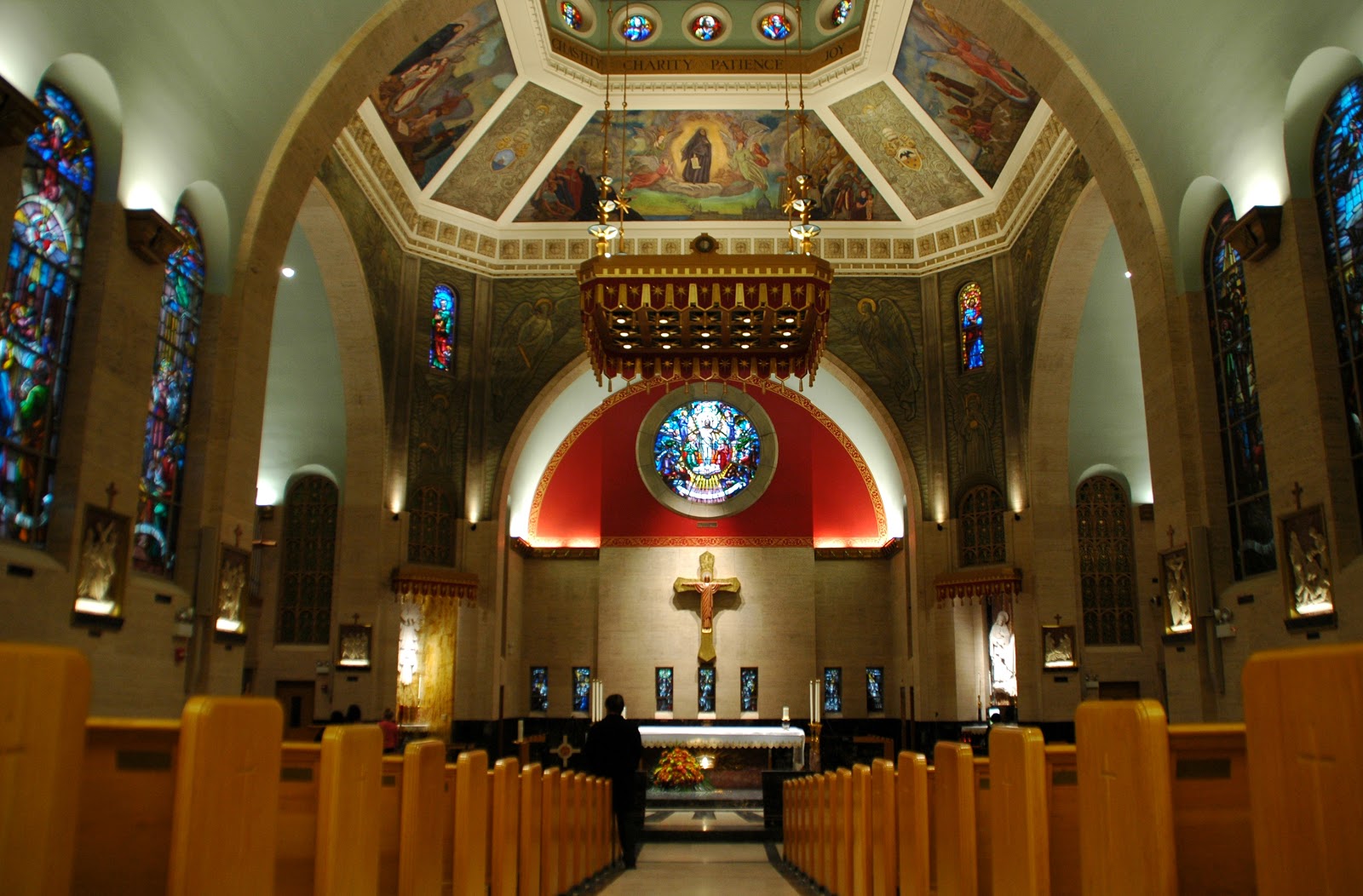
I work for the architectural firm that oversaw the restoration and addition to the chapel and though I had the fortune of taking part in many aspects of design and construction, a vast majority of my efforts were spent on the design and coordination of the exhibits about
Mother Cabrini's life and work and the recreation of the bedroom where she died.
The Shrine sits on the property of the former Columbus Hospital, a hospital Mother Cabrini founded in Chicago in 1905. It is the place where Mother Cabrini died in 1917. Along with the other sisters in the order that she founded, she spent her life helping the less fortunate by providing health care, education, and spiritual enrichment services. She ultimately founded 67 missions around the world and the Missionary Sisters continue their work today with the help of other organizations, religious, and lay people.
The exhibits that I designed were a collaborative effort with historian Ellen Skerrett and conservators,
Bernacki & Associates. It was a once in a lifetime opportunity to work on a project that pushed my skills and creativity and served a purpose that seemed much greater than the typical architectural projects that I work on.
The walls were covered with large custom-printed wallpapers with iconic images of institutions where Mother Cabrini worked, a map of her travels, and other aspects of the history of her life. Quotes by Mother Cabrini and testimonies of her work and life by others were carefully chosen and adhered to the walls with vinyl lettering. The wall coverings are the backdrop for supplemental images, text panels, and carefully arranged display cases showcasing objects that belonged to Mother Cabrini.
Bernacki & Associates fabricated all of the display cases and were instrumental in executing the difficult task of putting everything into place. A six foot tall case that showcases Mother Cabrini's habit and shoes was one of the more difficult displays to assemble. Several people were needed to maneuver the plexiglas covering.
A team of art hangers and carpenters helped complete the finishing touches. At the center of one exhibit is a portrait of Mother Cabrini, completed after a photograph taken in 1905. Forever shy to the camera, it is one of the few images of her and it has become iconic, reproduced in many media. It appeared in the households of many Americans after she was the first American citizen to become a saint in 1947. A small copy of it always hung in my grandmother's home.
All of the photographs in the exhibits are mounted to aluminum plates and mounted to the walls with cleats. Many of the images were scanned and enhanced by Paul Lane of Photo Source. The printing and mounting, as well as the printing of the wallpapers and text panels was done by
Printmakers Chicago in conjunction with
Digitial Imaging Resources. The text panels are printed on frosted acrylic panels that are mounted to the walls on metal standoffs.
The intent was to create an exhibit that was a layered experience. Though each wall is arranged thematically, the exhibit can unfold for viewer and new discoveries about the history could occur with each subsequent visit to the Shrine.
There is also a location for temporary exhibits. Currently, a portable tabernacle from Codogno, Italy is on exhibit and will remain so for another year. Some of the thematic areas include Mother Cabrini's early life, her travels, the institutions she founded, and the mission today.
One highlight for us while designing the exhibits was the discovery, in a collection of Mother Cabrini's prayer books, of her address book. It speaks of her gift for business practices and showcases the network of businessmen and heads of the church that she worked with across America. A custom-designed case displays the book, calling cards, and photos of key politicians and leaders whose names and contact information are in the book.

The centerpiece of the exhibit areas is a recreation of the room where Mother Cabrini died. All of the furnishings, artwork, and even lighting fixture were saved from the original room. Painstaking research was done on the history of this room. Originally in the now-demolished hospital and then as part of the Shrine, it was re-created several times and took many forms. The furnishings and art were conserved by Bernacki & Associates. The task seemed daunting as many of the pieces had been painted with varnish after Mother Cabrini's death and others were collapsing under their own weight. The intent was to create a room and conservation of furnishings that would match the period of the time that Mother Cabrini died. The result is a quiet and evocative space where people can contemplate and pray.

I hope that the housbloggers that typically follow my blog would find this post and some of the technical aspect of this work interesting. It is the first time where my interest in history and design have come together this way and it was a remarkable project to work on. More germane to Blog Action Day, I hope that people take the time to
visit the Shrine and are inspired by the selflessness and
work of the Missionary Sisters and are inspired to join others to become a part of something bigger than themselves.



 The reason for our trip gives some clue about the economic conditions of some parts of the country. Walking around the farming village, those conditions were magnified tenfold. Much of what I saw, quaint buildings in various stages of disrepair and tightly packed homes between which chickens roamed freely, was shocking to me.
 I am sure that on some level, I held a prejudice because I am a westerner and though not rich, am used to a more opulent style of life but there was something more. Being an architect, I couldn’t help but take notice of the infrastructure of this small conglomerate of homes. Wastewater flowed in narrow ditches between the homes and water for the village came from a single well and pump that was shared by many families.
 I am still not positive of the answers to these questions but after some research and from what I saw, it didn’t seem promising. It seems that this basic life necessity should be available to all people, no matter where they are or what economic background they come from. For the people that concerned me the most, those tiniest members of society that seem to have fallen through the cracks, something must be done.
 2. Live in an old home.
 6. Compost.
 7. Repair, don't replace.
  9. Put in some
  10. Install a rain